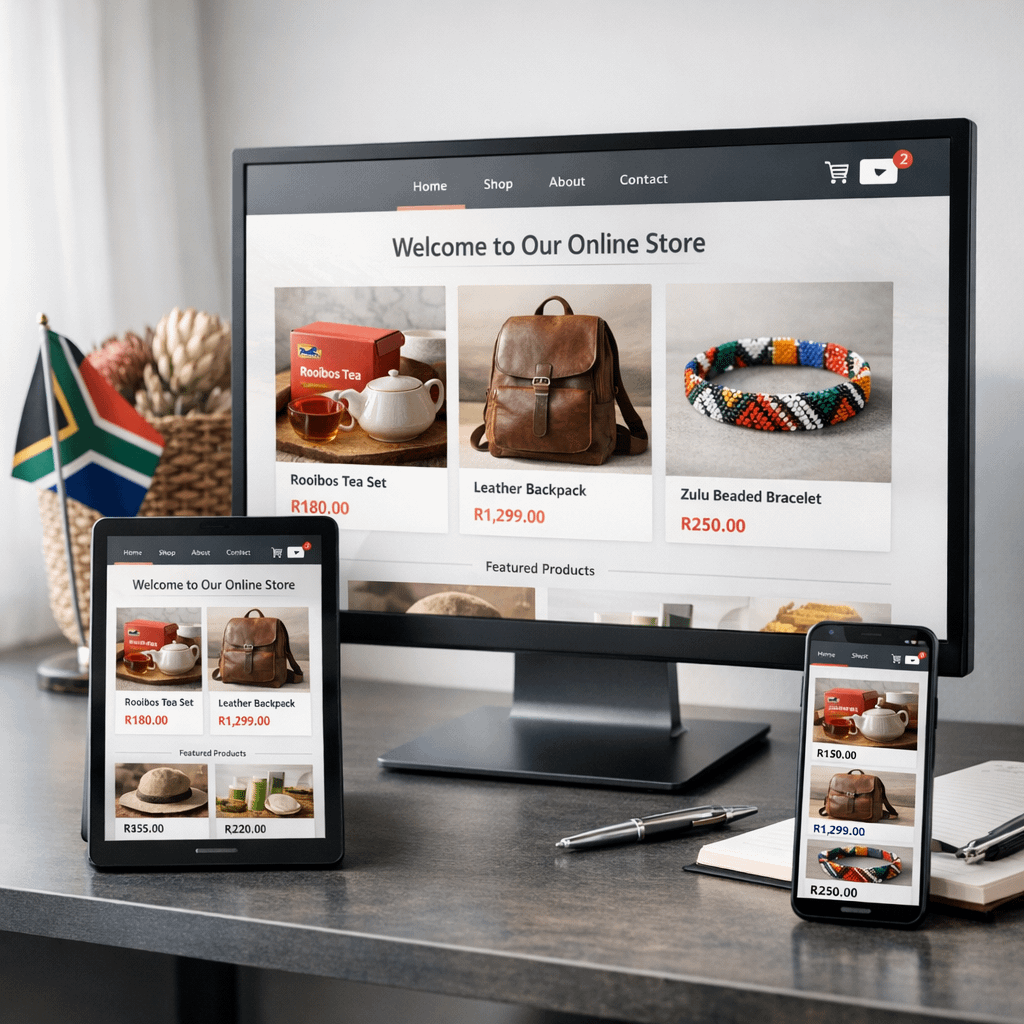
Modern ecommerce website design optimized for South African online shoppers across all devices
Ecommerce Website Design South Africa: 7 Essential Strategies to Boost Sales
By Morne de Heer | Published by Brand Nexus Studios
The digital revolution has transformed how South Africans shop, with online retail growing exponentially year after year. If you’re planning to launch an online store or revamp your existing digital presence, understanding ecommerce website design South Africa best practices is critical to your success.
Building a profitable online store requires more than just uploading products and hoping customers find you. You need strategic design choices that cater specifically to South African consumers, their shopping behaviors, payment preferences, and connectivity challenges.
This comprehensive guide walks you through seven essential strategies that separate thriving ecommerce businesses from those that struggle to convert visitors into paying customers. Whether you’re a startup entrepreneur or an established retailer expanding online, these insights will help you build a high-converting digital storefront.
The South African ecommerce landscape presents unique opportunities and challenges. From mobile-first shoppers navigating varied network speeds to specific payment gateway preferences and delivery expectations, your website design must address local market conditions while maintaining global best practices.
Why Ecommerce Website Design Matters for South African Businesses
Your ecommerce website serves as your digital storefront, sales team, and brand ambassador rolled into one. In South Africa’s competitive online marketplace, first impressions happen in milliseconds, and poor design drives potential customers straight to your competitors.
Research shows that 94% of first impressions relate to design, and 88% of online shoppers won’t return to a website after a bad user experience. These statistics become even more critical in the South African context, where trust remains a significant barrier to online shopping adoption.
Professional ecommerce website design South Africa solutions address specific local concerns. South African consumers want reassurance about security, clear delivery information, familiar payment options, and responsive customer support before they’ll trust a new online store with their money.
Beyond aesthetics, effective design directly impacts your bottom line. Strategic placement of call-to-action buttons, streamlined checkout processes, and mobile optimization can increase conversion rates by 200% or more. When thousands of visitors browse your products monthly, even small conversion improvements generate substantial revenue increases.
The South African Ecommerce Landscape in 2025
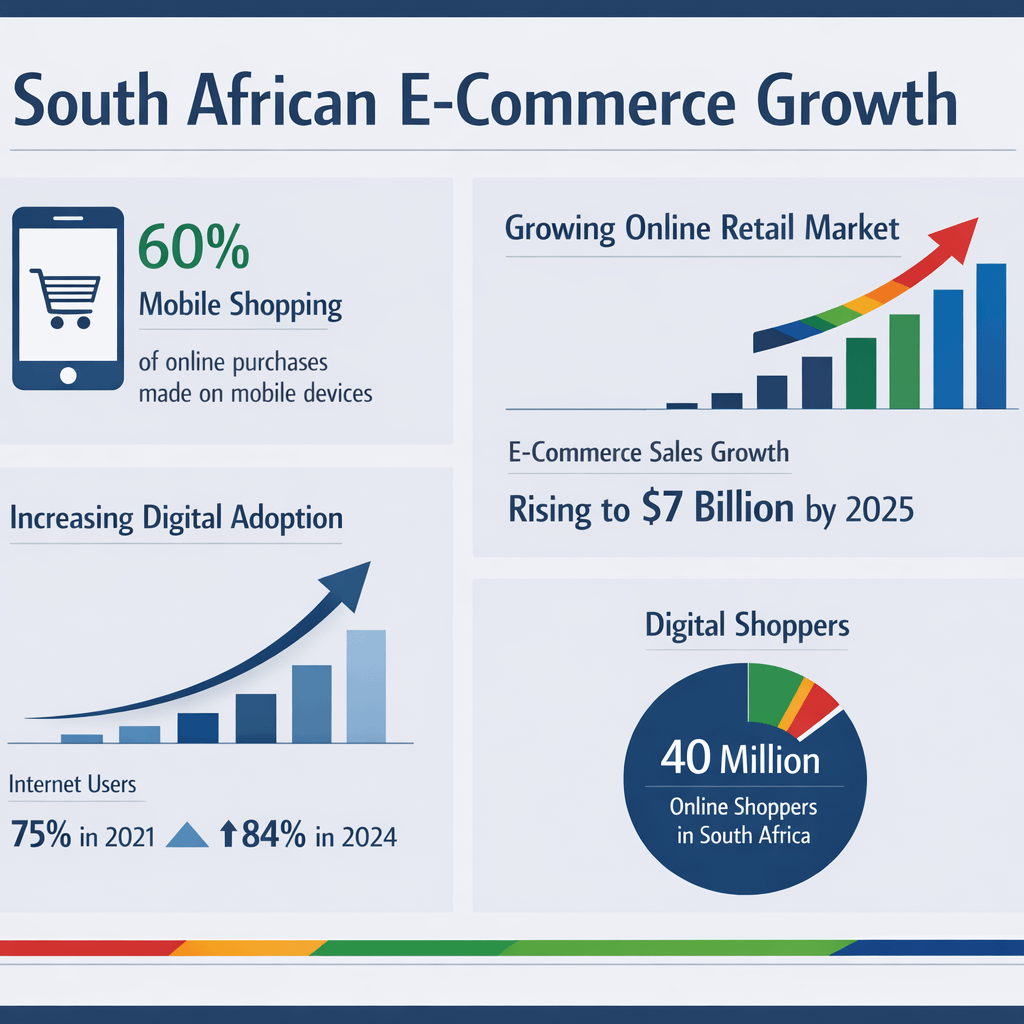
Understanding current market dynamics helps inform smarter design decisions. South Africa’s ecommerce market continues expanding rapidly, driven by increased smartphone penetration, improved logistics networks, and changing consumer attitudes toward online shopping.
Mobile commerce dominates the landscape, with over 60% of online transactions happening on smartphones and tablets. This mobile-first reality demands responsive design that delivers flawless experiences regardless of device or screen size.
Payment preferences also shape design requirements. While credit cards remain popular, instant EFT solutions, digital wallets, and buy-now-pay-later options have gained significant traction. Your checkout design must accommodate multiple payment methods without creating confusion or friction.
Delivery expectations have evolved too. South African shoppers now expect transparent shipping costs, multiple delivery options including collection points, real-time tracking, and realistic delivery timeframes. Your website design needs to communicate this information clearly throughout the shopping journey.
Strategy 1: Prioritize Mobile-First Design for Maximum Reach
Mobile devices account for the majority of ecommerce traffic in South Africa, making mobile-first design non-negotiable. This approach means designing for smartphone screens first, then scaling up to tablets and desktops, rather than the reverse.
Mobile-first ecommerce website design South Africa projects must address specific challenges. Many South African mobile users experience inconsistent connectivity and slower data speeds. Your design needs to load quickly even on 3G networks while maintaining functionality and visual appeal.
Essential Mobile Design Elements
Start with responsive frameworks that automatically adapt layouts to different screen sizes. Bootstrap, Foundation, and custom CSS Grid implementations all work well when properly configured for ecommerce functionality.
Touch-friendly interfaces are critical. Buttons and clickable elements should be at least 44×44 pixels to accommodate finger taps without frustration. Space interactive elements adequately to prevent accidental clicks that damage user experience.
Simplify navigation for small screens. Hamburger menus, sticky headers, and clearly defined category structures help mobile shoppers find products quickly. Implement search functionality prominently, as many mobile users prefer searching to browsing.
- Implement progressive image loading to improve perceived speed
- Use mobile-optimized carousels for product galleries
- Enable swipe gestures for intuitive navigation
- Optimize form fields for mobile keyboards
- Minimize required text input through dropdowns and selections
- Integrate mobile payment options like Apple Pay and Google Pay
- Test checkout flows on multiple devices and browsers
Page speed becomes absolutely critical on mobile. Compress images aggressively using WebP format with JPEG fallbacks. Implement lazy loading so images only download as users scroll. Minimize JavaScript and CSS files, and leverage browser caching to reduce repeat load times.
Consider implementing Accelerated Mobile Pages (AMP) for product pages and blog content. While AMP has limitations for complex ecommerce functionality, it can dramatically improve mobile search visibility and initial load times.
Testing Mobile Performance
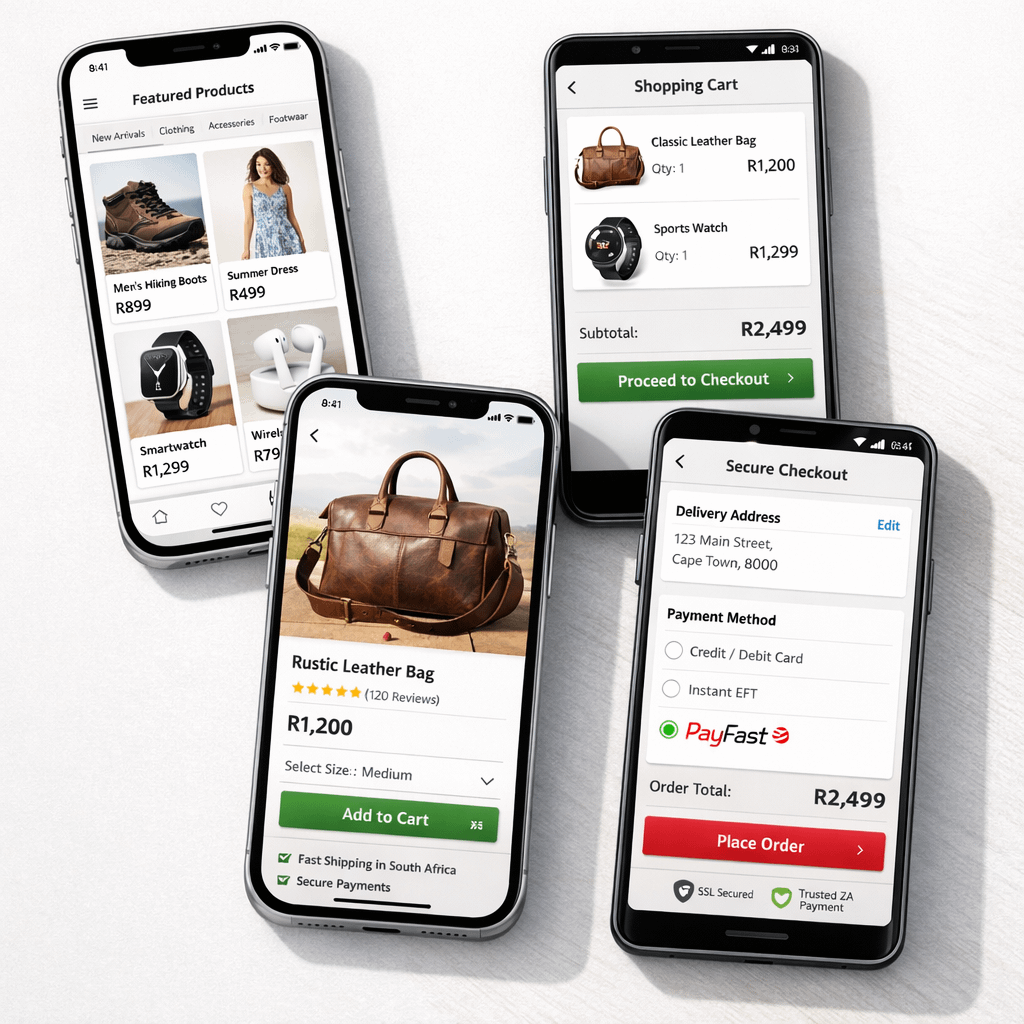
Regular testing ensures your mobile design performs as intended. Use Google’s Mobile-Friendly Test and PageSpeed Insights to identify technical issues. Test on actual devices, not just desktop browser emulators, as real-world performance often differs significantly.
Monitor mobile analytics closely. Track metrics like mobile bounce rates, conversion rates by device, and page load times. High mobile bounce rates often indicate design or performance problems that need immediate attention.
Conduct user testing with actual South African consumers on various devices and network conditions. Their feedback reveals friction points you might miss through internal testing alone.
Strategy 2: Streamline Checkout to Reduce Cart Abandonment
Cart abandonment rates in South Africa average around 70%, meaning seven out of ten shoppers who add products to their cart never complete purchases. Strategic checkout design can dramatically reduce this costly problem.
Complicated, lengthy, or confusing checkout processes are the primary culprits. Every additional step or required form field increases the likelihood shoppers will abandon their purchase. Your goal is frictionless completion from cart to confirmation.
Simplifying the Checkout Experience
One-page or two-page checkout flows perform significantly better than multi-step processes. Consolidate all required information onto as few screens as possible while maintaining clarity and organization.
Guest checkout options are essential. Forcing account creation before purchase drives away customers who want quick transactions. Allow guest checkout while offering optional account creation post-purchase to capture future business without creating barriers.
Progress indicators help when multi-step checkouts are necessary. Clear visual cues showing customers exactly where they are in the process and how many steps remain reduce anxiety and abandonment.
Auto-fill and address lookup functionality saves time and reduces errors. Integrate with services that auto-complete addresses based on postal codes, and enable browser auto-fill for returning customers.
- Display security badges and SSL certificates prominently
- Show accepted payment methods before checkout begins
- Calculate shipping costs early to prevent sticker shock
- Offer multiple delivery options with clear timeframes
- Enable coupon code entry without disrupting flow
- Provide clear error messages that guide corrections
- Include live chat support for checkout assistance
- Send abandoned cart recovery emails automatically
Form design significantly impacts completion rates. Use single-column layouts that are easier to scan and complete. Mark required fields clearly, minimize optional fields, and use appropriate input types that trigger correct mobile keyboards.
Trust signals throughout checkout reassure nervous shoppers. Display security seals, money-back guarantees, return policies, and customer service contact information prominently. Testimonials and trust badges reduce purchase anxiety.
Payment Gateway Integration
Offering familiar, trusted payment options is crucial for South African ecommerce success. PayFast remains the most popular choice, but smart stores offer multiple options to accommodate different customer preferences.
Integrate at least three payment methods: credit/debit cards, instant EFT, and a digital wallet option. Each payment method appeals to different customer segments, and offering choice increases overall conversion rates.
Ensure payment gateway integration is seamless and secure. Customers should never feel uncertain about whether their payment succeeded. Provide clear confirmation messages, email receipts immediately, and redirect to thank-you pages that confirm order details.
Consider buy-now-pay-later options like PayJustNow or Payflex. These services have gained significant popularity in South Africa and can increase average order values by making larger purchases more accessible.
Strategy 3: Optimize Product Pages for Conversion
Product pages are where browsers become buyers. Every element on these critical pages should guide visitors toward the add-to-cart button while providing all information needed to make confident purchase decisions.
High-quality product photography is non-negotiable. South African shoppers can’t physically examine products before buying, so images must compensate by showing multiple angles, close-up details, and products in use.
Creating Compelling Product Presentations
Use professional photography with consistent lighting and backgrounds. Show products from at least four angles, and include zoom functionality so customers can examine details closely. Lifestyle images showing products in real-world contexts help shoppers visualize ownership.
Video content increases conversion rates by up to 80%. Short product videos demonstrating features, showing scale, or explaining use cases provide information that static images cannot convey. Keep videos under 60 seconds for optimal engagement.
Product descriptions need to be comprehensive yet scannable. Use bullet points for specifications and features, but include detailed paragraphs addressing benefits, use cases, and differentiators. Write for humans first, incorporating keywords naturally rather than stuffing them awkwardly.
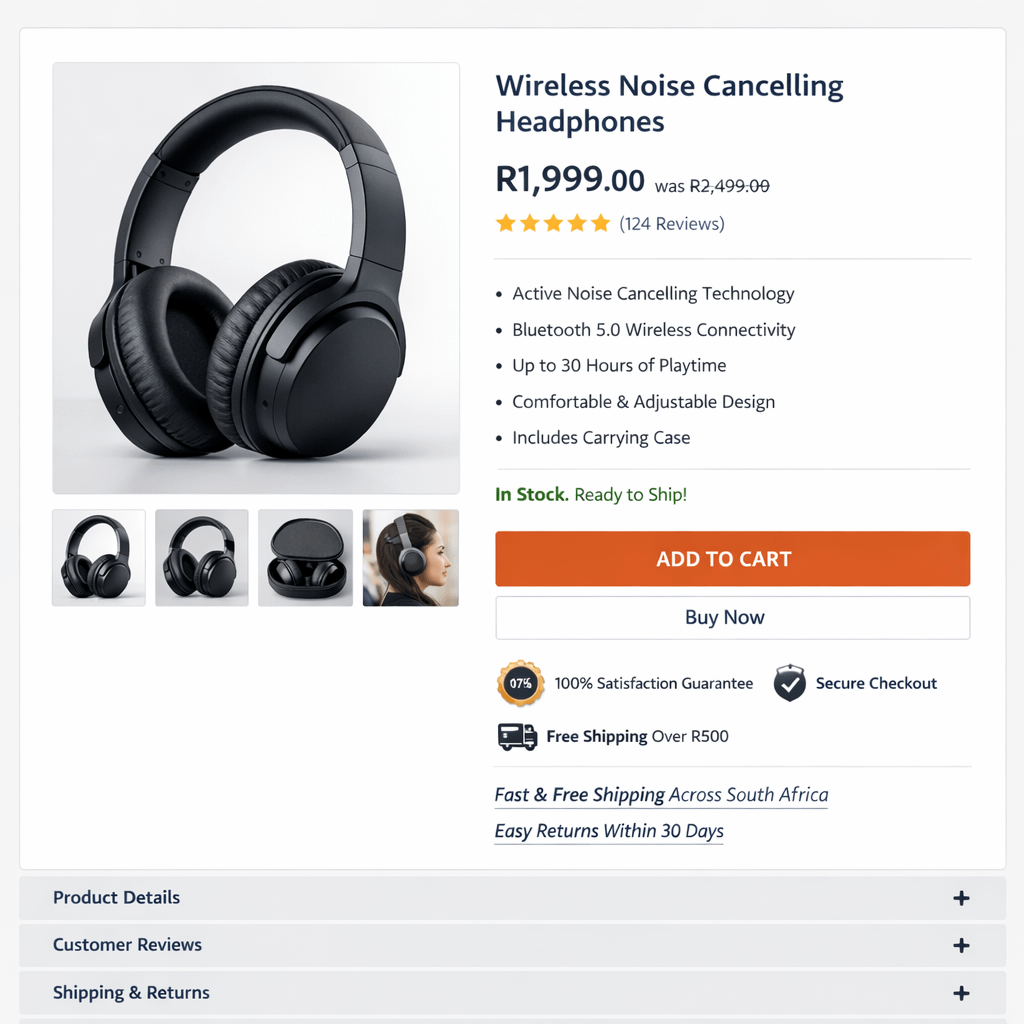
Pricing transparency builds trust. Display prices prominently in South African Rands with no hidden fees. If shipping costs vary, provide estimates or calculation tools. Show savings clearly when products are discounted, using strikethrough pricing to highlight value.
Social Proof and Trust Elements
Customer reviews dramatically impact purchase decisions. Display authentic reviews prominently, including both ratings and written feedback. Don’t hide negative reviews, as their presence increases overall credibility.
Implement schema markup for product reviews so star ratings appear in search results. This rich snippet data increases click-through rates and brings more qualified traffic to your products.
Stock availability information prevents disappointment. Show real-time stock levels, and if items are low in stock, create urgency with messages like “Only 3 left in stock.” For out-of-stock items, offer email notifications when products return.
- Add clear size guides and measurement charts
- Include detailed shipping and return information
- Display related products and cross-sells strategically
- Show recently viewed items to aid comparison
- Implement wishlist functionality for later consideration
- Add social sharing buttons for products
- Include detailed FAQ sections for complex products
Call-to-Action Optimization
Your add-to-cart button deserves careful attention. Use contrasting colors that stand out against your design while maintaining brand consistency. Make buttons large enough to be unmissable, especially on mobile devices.
Button copy matters more than many realize. “Add to Cart” works well, but testing variations like “Buy Now,” “Get Yours Today,” or “Add to Bag” might perform better depending on your audience and products.
Position add-to-cart buttons prominently above the fold and repeat them below product descriptions for longer pages. Sticky add-to-cart buttons that remain visible while scrolling can increase mobile conversions significantly.
Strategy 4: Implement Robust Search and Navigation Systems
Shoppers who can’t find products quickly leave for competitors. Intuitive navigation and powerful search functionality are foundational elements of successful ecommerce website design South Africa projects.
Your navigation structure should match how customers think about your products, not how your warehouse organizes inventory. User testing reveals whether your category logic makes sense to actual shoppers.
Designing Effective Navigation
Limit main navigation to seven or fewer top-level categories. Beyond seven options, choice paralysis sets in and decision-making becomes difficult. Use mega menus for stores with extensive product ranges, displaying subcategories, featured products, and promotional content in organized columns.
Breadcrumb navigation helps shoppers understand their location within your site hierarchy and provides easy backtracking. This simple element reduces bounce rates and improves overall user experience.
Filter and sort options are critical for category pages. Allow customers to narrow results by price range, brand, color, size, rating, and other relevant attributes. Make filters easy to apply and clear, with visible counts showing how many products match each option.
Sticky navigation that remains accessible while scrolling improves usability, especially on mobile devices. Users shouldn’t need to scroll back to the top to access menus or search functionality.
Search Functionality That Delivers Results
Site search is one of the most important conversion tools. Shoppers who use search convert at 2-3 times higher rates than those who don’t, because they’re actively looking for specific products.
Implement autocomplete functionality that suggests products as users type. This speeds up search and helps customers discover products even when they’re unsure of exact names or spellings.
Your search algorithm should handle common misspellings, synonyms, and partial matches. If someone searches for “cellphone,” your system should show results for “smartphone” and “mobile phone” as well.
- Display search suggestions prominently in header
- Show thumbnail images in search results
- Include filters on search results pages
- Track zero-result searches to identify gaps
- Implement voice search for mobile users
- Add recently searched items for quick access
- Provide alternative suggestions when searches fail
Search analytics reveal valuable insights. Monitor what people search for, which searches produce no results, and which search terms lead to conversions. This data informs inventory decisions, content creation, and SEO strategy.
Consider implementing visual search capabilities. This emerging technology allows shoppers to upload images and find similar products in your catalogue, particularly valuable for fashion and home decor categories.
Strategy 5: Build Trust Through Security and Transparency
Online shopping requires trust. South African consumers are particularly cautious due to well-publicized fraud incidents and data breaches. Your website design must proactively address security concerns and build confidence at every touchpoint.
SSL certificates are the bare minimum requirement. Every ecommerce website design South Africa project should implement HTTPS across the entire site, not just checkout pages. Modern browsers flag non-HTTPS sites as unsafe, immediately damaging credibility.
Essential Security Measures
Display security badges and trust seals prominently, especially near payment areas. Norton, McAfee, and PCI DSS compliance badges reassure customers that their data is protected. Only use legitimate badges you’re entitled to display, as fraudulent trust seals damage credibility when discovered.
Transparent privacy policies and terms of service are legal requirements that also build trust. Write these documents in clear language, not just legal jargon. Explain exactly how you collect, use, and protect customer data.
Two-factor authentication for customer accounts adds security without significant friction. Offer it as an option for security-conscious shoppers who want extra protection for their accounts and saved payment information.
Regular security audits and updates protect your business and customers. Outdated platforms, plugins, and themes create vulnerabilities that hackers exploit. Maintain current software versions and implement security patches promptly.

Transparency That Converts
Clear contact information demonstrates legitimacy. Display your physical address, phone number, and email address prominently. Consider adding a map to your physical location if you have a brick-and-mortar presence.
Shipping information should be transparent and detailed. Clearly communicate delivery timeframes, shipping costs, and coverage areas before customers reach checkout. Unexpected shipping costs are among the top reasons for cart abandonment.
Return and refund policies significantly impact purchase confidence. Display these policies prominently on product pages, not just buried in footer links. The easier your return process, the more comfortable customers feel making purchases.
- Publish detailed FAQ sections addressing common concerns
- Display customer service hours and response times
- Show real customer testimonials with photos when possible
- Include company registration and tax numbers
- Highlight guarantees and warranties clearly
- Provide multiple contact channels including live chat
- Show social media profiles to demonstrate legitimacy
About pages that tell your story humanize your brand. Share your mission, introduce team members, and explain what makes your business unique. Customers prefer buying from real people, not faceless corporations.
Professional website design services understand how to balance security requirements with user experience. The right partner implements robust protection without creating friction that drives away customers.
Strategy 6: Leverage SEO to Drive Organic Traffic
Beautiful design means nothing if potential customers can’t find your website. Search engine optimization must be baked into your ecommerce website design South Africa approach from the beginning, not bolted on as an afterthought.
Organic search drives the highest-quality traffic to ecommerce sites. Shoppers finding you through Google are actively searching for products you sell, making them far more likely to convert than random visitors.
On-Page SEO Fundamentals
Every product page needs unique, optimized title tags and meta descriptions. Include primary keywords naturally while writing compelling copy that encourages clicks from search results. Avoid duplicate content across similar products.
URL structure impacts both SEO and usability. Use clean, descriptive URLs that include keywords and make sense to humans. Avoid URLs filled with random characters, session IDs, or unnecessary parameters.
Header tags (H1, H2, H3) provide structure that search engines and screen readers use to understand content hierarchy. Use one H1 per page (typically your product name), and organize descriptions with relevant H2 and H3 subheadings.
Image optimization serves dual purposes. Compressed images improve page speed while descriptive alt text helps search engines understand visual content and improves accessibility for visually impaired users. Name image files descriptively rather than using default camera names.
Technical SEO Considerations
Site speed directly impacts search rankings and conversions. Google considers page speed a ranking factor, and Amazon found that every 100ms delay costs them 1% in sales. Compress images, minimize code, leverage browser caching, and use content delivery networks to maximize speed.
Mobile-friendliness is now Google’s primary ranking factor through mobile-first indexing. Your mobile design isn’t just about user experience anymore, it directly determines search visibility.
Schema markup helps search engines understand your content and display rich results. Implement product schema with pricing, availability, and review data. Rich snippets with star ratings and pricing information significantly increase click-through rates from search results.
- Create XML sitemaps for easy crawling and indexing
- Implement canonical tags to avoid duplicate content issues
- Use robots.txt to control search engine access
- Fix broken links and redirect outdated pages properly
- Optimize for Core Web Vitals metrics
- Implement breadcrumb schema for better search display
- Create an SEO-friendly blog for content marketing
Content Strategy for Ecommerce SEO
Thin product descriptions hurt rankings and conversions. Avoid manufacturer descriptions that appear on hundreds of other sites. Write unique, detailed descriptions that answer customer questions and naturally incorporate relevant keywords.
Blog content attracts top-of-funnel traffic and establishes expertise. Create buying guides, how-to articles, and industry insights that help potential customers while targeting informational keywords. This content brings visitors who aren’t ready to buy immediately but may convert later.
Category page optimization often gets overlooked. These high-level pages should include unique introductory content, not just product grids. Write compelling descriptions that incorporate keywords while providing value to shoppers.
Internal linking distributes authority throughout your site and helps search engines discover pages. Link from high-authority pages to important product categories, and connect related products through contextual links in descriptions.
Working with experts like Brand Nexus Studios’ SEO services ensures your ecommerce platform is optimized for search visibility from launch, avoiding costly redesigns to fix foundational SEO problems later.
Strategy 7: Integrate Analytics and Continuous Optimization
Launch day is just the beginning. Successful ecommerce businesses continuously analyze performance data and optimize based on real user behavior. Build analytics into your website design from day one.
Google Analytics provides foundational insights into traffic sources, user behavior, and conversion paths. Proper ecommerce tracking reveals which products sell, where customers drop off, and which marketing channels deliver the best return on investment.
Essential Metrics to Monitor
Conversion rate is your most important metric. Track overall site conversion rate plus individual product and category performance. Identify top performers and underperformers, then investigate why certain products or pages convert better than others.
Cart abandonment rate reveals checkout friction. High abandonment points to problems with shipping costs, complicated checkout processes, or trust issues. Segment abandonment data by traffic source and device to identify specific problems.
Average order value (AOV) indicates how much customers spend per transaction. Increase AOV through product recommendations, bundles, volume discounts, and free shipping thresholds that encourage larger purchases.
Customer lifetime value (CLV) shows the total revenue a customer generates over their relationship with your business. Focus on increasing CLV through email marketing, loyalty programs, and exceptional post-purchase experiences that encourage repeat business.
- Track page load times across different pages and devices
- Monitor bounce rates by traffic source and landing page
- Analyze on-site search queries and zero-result searches
- Review customer acquisition costs by channel
- Track return rates and customer service inquiries
- Monitor mobile versus desktop performance separately
- Analyze user flow through checkout process
Testing and Optimization
A/B testing removes guesswork from optimization decisions. Test different homepage layouts, product page designs, checkout flows, and call-to-action buttons. Let data guide design decisions rather than personal preferences or assumptions.
Heatmaps and session recordings show exactly how users interact with pages. Tools like Hotjar or Microsoft Clarity reveal where people click, how far they scroll, and where they struggle. These insights identify friction points that analytics numbers alone won’t reveal.
User feedback provides qualitative insights that complement quantitative data. Implement post-purchase surveys, exit-intent popups asking why visitors are leaving, and customer service feedback collection. Direct customer input often reveals problems you’d never discover through analytics alone.
Regular performance audits keep your site healthy. Monthly reviews of site speed, broken links, SEO issues, and security vulnerabilities prevent small problems from becoming major failures. Automated monitoring tools alert you to critical issues requiring immediate attention.
Competitor analysis informs optimization priorities. Monitor what successful competitors do well, which features they offer, and how they structure their customer experience. Don’t copy blindly, but learn from others’ successes and failures.
Choosing the Right Ecommerce Platform for South African Businesses
Platform selection fundamentally impacts your website’s capabilities, costs, and scalability. The right choice depends on your product range, technical expertise, budget, and growth ambitions.
WooCommerce: Flexibility and Control
WooCommerce powers more South African online stores than any other platform. Built on WordPress, it offers unlimited customization potential and extensive plugin ecosystems. You maintain complete control over your site and data.
WooCommerce suits businesses wanting customization freedom without ongoing subscription fees. Initial development costs are higher, but long-term expenses are lower than SaaS platforms. You’ll need reliable hosting and basic technical knowledge or professional support for maintenance.
The platform integrates seamlessly with South African payment gateways like PayFast and supports extensive product variations, shipping options, and inventory management. Thousands of free and premium plugins extend functionality for virtually any requirement.
Shopify: Ease of Use and Reliability
Shopify provides hosted ecommerce with minimal technical requirements. Everything is managed for you, from hosting and security to updates and uptime. This simplicity comes with monthly subscription fees and transaction fees unless you use Shopify Payments.
The platform works well for businesses prioritizing ease of use over customization flexibility. Setup is quick, the admin interface is intuitive, and extensive app marketplaces add functionality without custom development.
Shopify’s main drawback for South African businesses is the unavailability of Shopify Payments locally, meaning you’ll pay transaction fees on top of subscription costs and payment gateway fees. Calculate total costs carefully before committing.
Magento: Enterprise-Level Power
Magento (now Adobe Commerce) serves large enterprises with complex requirements, extensive product catalogues, and multiple storefronts. The platform offers tremendous power but requires significant technical expertise and resources.
Magento suits established businesses with thousands of products, complex pricing rules, and multi-channel sales. The platform handles high traffic volumes and sophisticated integrations that would overwhelm simpler solutions.
Development and maintenance costs are substantially higher than other platforms. Unless your business requires enterprise-level features, simpler solutions likely provide better value.
Whatever platform you choose, partnering with experienced developers like Brand Nexus Studios ensures proper implementation, optimization, and ongoing support tailored to South African market conditions.
Local Payment Gateway Integration
Payment gateway selection directly impacts conversion rates. South African shoppers have strong preferences for familiar, trusted payment options. Offering multiple methods accommodates different customer preferences and increases overall conversion rates.
Popular South African Payment Gateways
PayFast dominates the South African market with competitive transaction fees, easy integration, and comprehensive payment options including credit cards, instant EFT, and various digital wallets. The platform’s widespread recognition builds immediate trust with shoppers.
Yoco appeals to businesses wanting unified payment processing across online and physical stores. The platform offers competitive fees and seamless integration between digital and in-person sales channels.
Peach Payments provides robust fraud detection and supports multiple payment methods. The platform suits businesses prioritizing security and requiring advanced payment features like tokenization and subscription billing.
PayGate offers extensive integration options and supports major credit cards and banking options. The platform has operated in South Africa for over two decades, providing proven reliability.
Ozow specializes in instant EFT payments, offering faster settlement than traditional methods. This gateway suits businesses wanting immediate payment confirmation and quick cash flow.
Implementing Multiple Payment Options
Offer at least three payment methods to maximize conversions. Different customers prefer different options, and lack of preferred payment methods is a common abandonment reason.
Display accepted payment methods prominently before checkout begins. This transparency prevents customers from investing time adding products to cart only to discover their preferred payment option isn’t available.
Consider buy-now-pay-later services like PayJustNow, Payflex, and MoreTyme. These installment payment options reduce purchase barriers for higher-value items and can significantly increase average order values.
Digital wallets like Apple Pay, Google Pay, and Samsung Pay streamline mobile checkout. One-tap payments dramatically reduce friction on smartphones where typing is cumbersome.
Shipping and Fulfillment Integration
Delivery capabilities significantly impact customer satisfaction and repeat business. South African ecommerce requires flexible shipping options that accommodate varied customer preferences and geographic spread.
Courier Service Integration
Integrate directly with major courier services for automated quote generation and tracking. The Courier Guy, Fastway, RAM, and Aramex all offer API integrations that streamline operations and provide customers with real-time shipping information.
Pargo and similar collection point networks provide convenient alternatives to home delivery. These services suit customers with security concerns, flexible pickup preferences, or delivery address challenges.
Real-time shipping calculations improve transparency and reduce cart abandonment. Display accurate costs based on customer location and cart contents before checkout, eliminating surprise fees that drive abandonment.
Delivery Options That Convert
Offer multiple delivery speeds at different price points. Budget-conscious customers choose slower, cheaper options while urgent buyers pay premium for faster delivery. Choice increases satisfaction across customer segments.
Free shipping thresholds encourage larger orders. Set minimum order values for free shipping just above your current average order value to increase basket sizes while maintaining profitability.
Clearly communicate delivery timeframes in business days, not vague terms. “Delivered within 3-5 business days” sets proper expectations better than “fast delivery.”
Track and communicate delivery status proactively. Automated emails updating customers on order processing, dispatch, and delivery build confidence and reduce customer service inquiries.
Common Ecommerce Website Design Mistakes to Avoid
Learning from others’ mistakes saves time and money. These common errors plague many South African ecommerce sites, hurting conversions and damaging brand perception.
Design and Usability Mistakes
Poor mobile optimization remains surprisingly common despite mobile’s dominance. Sites that look great on desktop but frustrate mobile users miss the majority of potential customers. Test thoroughly on actual devices, not just desktop browser emulators.
Complicated navigation confuses shoppers and drives them away. If visitors can’t find products within two or three clicks, they’ll leave for competitors with clearer structures. Simplify ruthlessly and test with actual users.
Slow loading speeds kill conversions before shoppers see your products. Optimize images aggressively, minimize code bloat, and invest in quality hosting. Every second of delay measurably reduces conversion rates.
Poor product photography fails to compensate for the inability to physically examine items. Invest in professional images showing multiple angles, details, and real-world context. Quality photography directly correlates with higher conversion rates.
Functional and Technical Mistakes
Forcing account creation before purchase adds unnecessary friction. Allow guest checkout while offering account creation post-purchase for future convenience without creating barriers to first-time buyers.
Hidden costs that appear at checkout destroy trust and drive abandonment. Display shipping costs, taxes, and fees early in the shopping journey so customers know total costs before investing time in checkout.
Limited payment options exclude potential customers. South African shoppers have diverse payment preferences. Accommodate credit cards, instant EFT, and digital wallets at minimum.
Inadequate security signals fail to build necessary trust. Display SSL certificates, security badges, and clear privacy policies prominently. Address security concerns proactively rather than assuming customers will trust you.
- Avoid auto-playing videos and music that frustrate visitors
- Don’t hide contact information or customer service options
- Never use intrusive popups that block content immediately
- Don’t ignore mobile users with desktop-only features
- Avoid complicated return policies that reduce purchase confidence
- Don’t neglect SEO fundamentals during design and development
- Never launch without thorough cross-browser and device testing
Launching without analytics tracking wastes valuable data. Implement proper tracking from day one to understand user behavior and identify optimization opportunities immediately.
The Role of Content Marketing in Ecommerce Success
Content marketing drives organic traffic, establishes expertise, and nurtures customers throughout their buying journey. Strategic content creation complements your ecommerce website design South Africa efforts by attracting potential customers before they’re ready to purchase.
Blog Content Strategy
Educational blog posts attract top-of-funnel traffic searching for information rather than products. Create buying guides, how-to articles, industry insights, and problem-solving content that demonstrates expertise while incorporating relevant keywords.
Product comparison articles help shoppers make informed decisions while subtly positioning your products favorably. These pieces target high-intent keywords and often convert well because readers are actively evaluating purchases.
Customer success stories and case studies build social proof while showcasing real-world applications. These narratives connect emotionally and demonstrate value better than product descriptions alone.
Seasonal and trend-based content capitalizes on timely interest. Create holiday gift guides, back-to-school articles, or trend spotlights that attract traffic during peak shopping seasons.
Visual Content
Video content engages more effectively than text alone. Create product demonstrations, unboxing videos, tutorials, and brand stories that connect with visual learners and increase time on site.
User-generated content like customer photos and videos builds authenticity. Encourage customers to share images using your products, then feature this content on product pages and social media.
Infographics simplify complex information and earn backlinks from other sites. Create shareable visual content related to your industry that establishes expertise while building SEO authority.
High-quality content combined with strategic content marketing services drives organic traffic that converts into customers while building long-term brand equity and search visibility.
Frequently Asked Questions
How much does ecommerce website design cost in South Africa?
Ecommerce website design costs in South Africa vary significantly based on complexity and features. Basic online stores using platforms like WooCommerce start from R15,000 to R30,000. Mid-range custom designs with advanced features cost between R40,000 and R80,000. Enterprise-level solutions with custom integrations and extensive product catalogues can exceed R150,000. Monthly maintenance, hosting, and security updates add R1,500 to R5,000 to ongoing costs.
Which ecommerce platform is best for South African businesses?
WooCommerce remains the most popular choice for South African ecommerce businesses due to its flexibility, extensive local payment gateway support, and cost-effectiveness. Shopify offers excellent ease of use but involves monthly subscription fees. Magento suits larger enterprises with complex requirements. The best platform depends on your budget, technical expertise, product range, and growth plans. Most small to medium businesses find WooCommerce ideal for South African market conditions.
What payment gateways work best for South African ecommerce sites?
Popular payment gateways for South African ecommerce include PayFast, Yoco, Peach Payments, PayGate, and Ozow. PayFast is widely used due to low transaction fees and easy integration. Yoco appeals to businesses wanting unified online and in-store payments. Peach Payments offers robust fraud protection. Always offer multiple payment options including credit cards, instant EFT, and digital wallets to maximize conversion rates.
How long does it take to build an ecommerce website in South Africa?
Timeline for ecommerce website development in South Africa depends on project scope. Simple WooCommerce stores with basic customization take 3 to 6 weeks. Mid-range custom designs require 8 to 12 weeks. Complex enterprise solutions with custom features and integrations can take 4 to 6 months. Factors affecting timeline include product catalogue size, custom functionality requirements, content preparation, and revision rounds.
Do I need SSL certificates and security features for my South African online store?
Yes, SSL certificates are absolutely essential for ecommerce websites in South Africa. They encrypt sensitive customer data, enable HTTPS protocol, and build trust with shoppers. Modern browsers flag non-HTTPS sites as unsafe, dramatically reducing conversions. Additionally, implement security measures like two-factor authentication, regular security audits, PCI DSS compliance for payment processing, and automatic backups to protect your business and customer data.
How can I optimize my ecommerce site for mobile users in South Africa?
Mobile optimization is critical as over 60% of South African online shoppers use smartphones. Implement responsive design that adapts to all screen sizes, optimize images to load quickly on mobile networks, simplify checkout to minimize steps, use large touch-friendly buttons, enable mobile payment options like Apple Pay and Google Pay, and test regularly on various devices. Fast loading speeds are especially important given South Africa’s varied mobile network quality.
What makes an ecommerce website successful in the South African market?
Successful South African ecommerce websites combine fast loading speeds, mobile-first design, multiple local payment options, clear shipping information with realistic delivery times, excellent product photography, detailed descriptions, customer reviews, transparent pricing in Rands, responsive customer support, and security features. Understanding local shopping behaviors, offering flexible delivery options including collection points, and building trust through professional design all contribute to higher conversion rates and customer loyalty.
Should I integrate my ecommerce website with local courier services?
Yes, integrating with South African courier services significantly improves customer experience and operational efficiency. Popular integrations include The Courier Guy, Fastway, RAM, Pargo, and Aramex. These integrations enable real-time shipping calculations, automated label generation, tracking updates, and collection point options. Offering multiple delivery choices including door-to-door, collection points, and same-day delivery in major metros increases conversion rates and customer satisfaction.
Taking Your South African Ecommerce Business to the Next Level
Building a successful online store requires more than just listing products and hoping for sales. Strategic ecommerce website design South Africa projects address local market conditions while implementing global best practices that drive conversions.
The seven strategies outlined in this guide provide a roadmap for creating high-performing online stores. From mobile-first design and streamlined checkout to robust security and continuous optimization, each element contributes to overall success.
Remember that ecommerce is not a set-it-and-forget-it endeavor. Markets evolve, technologies advance, and customer expectations change. Successful businesses continuously analyze performance, test improvements, and adapt to maintain competitive advantages.
South Africa’s ecommerce market continues growing rapidly, creating tremendous opportunities for businesses willing to invest in professional digital presence. Whether you’re launching a new venture or improving an existing store, focusing on user experience, trust-building, and conversion optimization positions you for long-term success.
The difference between struggling online stores and thriving ecommerce businesses often comes down to execution quality. Professional design, strategic optimization, and ongoing refinement separate market leaders from also-rans.
Don’t let poor website design hold your business back. Ready to build an ecommerce website that converts South African shoppers into loyal customers? Contact the digital marketing experts at Brand Nexus Studios today at info@brandnexusstudios.co.za to discuss your ecommerce vision and receive a customized proposal.
Share this guide with fellow entrepreneurs building online businesses, and subscribe to our newsletter for more actionable digital marketing insights tailored to the South African market.
References
About the Author