
Weighing PWA vs native app for business decisions in 2025.
PWA vs Native App: Ultimate 2025 Guide
By Morne de Heer | Published by Brand Nexus Studios | September 19, 2025

In today’s digital landscape, the choice between PWA vs native app can define your business trajectory. As we step into 2025, progressive web apps (PWAs) are transforming how companies engage users, blending web accessibility with app-like functionality. But do they truly rival traditional native apps?
This comprehensive guide delves into the strategic dilemma, equipping businesses and developers with insights to choose wisely. PWAs are bridging the app-web divide, potentially slashing costs while enhancing user experiences. Let’s explore the details and uncover what 2025 holds.
Understanding Progressive Web Apps (PWAs)
Progressive web apps represent a hybrid approach, merging the best of websites and mobile applications. They load quickly, function offline, and can be added to home screens without app store hurdles.
Developed using standard web technologies like HTML, CSS, and JavaScript, PWAs adapt seamlessly to various devices. This versatility allows businesses to reach diverse audiences efficiently, without platform-specific constraints.
For instance, major brands such as Twitter (now X) and Starbucks have embraced PWAs, reporting significant boosts in user retention and engagement. These real-world implementations demonstrate PWAs’ practical value in competitive markets.

However, PWAs depend on browser compatibility. While modern browsers support them effectively, legacy versions may present challenges, requiring thorough testing across environments.
Testing ensures consistent performance, from desktop to mobile. Developers must prioritize cross-browser compatibility to deliver reliable experiences, avoiding potential pitfalls in user satisfaction.
Beyond basics, PWAs leverage modern APIs for advanced features. This evolution positions them as viable alternatives to native apps in many scenarios.
As adoption grows, PWAs are projected to capture a larger market share. Statistics indicate the PWA market could exceed $15 billion by 2025, reflecting surging interest across industries.
This growth underscores PWAs’ potential to reshape digital strategies, offering scalable solutions for businesses of all sizes.
Key Features of PWAs
- Offline capabilities powered by service workers for uninterrupted access.
- Push notifications to maintain user engagement and drive returns.
- Responsive designs that adapt to any screen size effortlessly.
- Secure HTTPS connections ensuring data protection and trust.
- Fast loading times through caching strategies and optimization.
- Home screen installation mimicking native app convenience.
- SEO-friendly structure boosting organic visibility.
These attributes make PWAs feel remarkably native while retaining web-based advantages. For businesses, this translates to lower entry barriers and higher potential returns.
Moreover, PWAs support progressive enhancement, starting basic and adding features as capabilities allow. This approach ensures broad accessibility without sacrificing advanced functionality.
In 2025, with HTTP/3 adoption, PWAs are becoming even faster and more secure, narrowing the gap with native apps further.
As technology advances, PWAs continue to evolve, incorporating AI and ML for personalized experiences, enhancing their appeal.
What Are Native Apps?
Native apps are purpose-built for specific operating systems, such as iOS or Android, using platform-native languages like Swift or Kotlin. This specialization enables optimal performance and deep hardware integration.
Such apps access device features fully, including cameras, GPS, and sensors, making them ideal for complex applications requiring precision.
Games like Fortnite exemplify native apps’ strengths, delivering immersive graphics and responsive controls that PWAs struggle to match in intensity.
Yet, development involves separate codebases for each platform, increasing complexity and costs. Updates often require app store approvals, delaying rollouts.
Native apps provide a polished, OS-integrated feel, enhancing user loyalty through consistent interfaces.
In industries like finance or healthcare, where security and performance are paramount, native apps remain preferred for their robust capabilities.
However, the high development costs can deter startups, pushing them towards more affordable alternatives like PWAs.
As per recent analyses, native apps can cost 30-50% more to develop than PWAs due to multiple platform requirements.
This cost differential is a key factor in the ongoing PWA vs native app debate.
Advantages of Native Development
- Superior performance optimized for device hardware.
- Full access to all device APIs and features.
- Consistent user interface aligning with OS standards.
- Built-in security measures for sensitive data.
- Offline functionality without additional scripting.
- App store distribution for credibility and discoverability.
- Advanced graphics and animations for engaging experiences.
These benefits make native apps attractive for enterprises demanding top-tier solutions. Nevertheless, escalating costs pose challenges.
Native development also allows for better monetization through in-app purchases and subscriptions, integrated seamlessly with app stores.
In 2025, with cross-platform tools like Flutter, some costs are mitigated, but native still leads in performance-critical areas.
For specific industries like gaming or AR, native’s advantages are irreplaceable, ensuring immersive user interactions.
PWA vs Native App: Key Differences
The PWA vs native app comparison reveals stark contrasts in approach and outcomes. Let’s examine them closely.
| Aspect | PWA | Native App |
|---|---|---|
| Development Cost | Lower, unified codebase | Higher, platform-specific |
| Performance | Strong, continually improving | Optimal, hardware-tuned |
| Distribution | URL-accessible, SEO-optimized | App store exclusive |
| Offline Access | Enabled via caching | Inherent support |
| Updates | Seamless, no approvals needed | Subject to store reviews |
| Device Integration | Limited to browser APIs | Full hardware access |
| Maintenance | Simplified, single version | Complex, multiple versions |
This overview highlights essential trade-offs. Select based on your project’s priorities and constraints.
For deeper insights into digital optimization, visit our SEO services.
Expanding on costs, PWAs can reduce maintenance by 33% compared to native apps, as they avoid multiple app store managements.
Performance-wise, while natives excel, PWAs with WebAssembly are handling more complex tasks effectively.
Part 1: The Business Angle on PWA vs Native App
Businesses evaluating PWA vs native app focus on efficiency, reach, and ROI. PWAs often emerge as cost-effective, enabling rapid scaling.
By utilizing a single codebase, PWAs can cut development expenses by up to 70%, accelerating market entry and allowing iterative improvements.
For startups and SMEs, this means competing effectively without substantial upfront investments. Quick deployments facilitate testing and refinement based on real user feedback.
Additionally, PWAs enhance discoverability through search engine indexing, driving organic traffic and reducing acquisition costs.
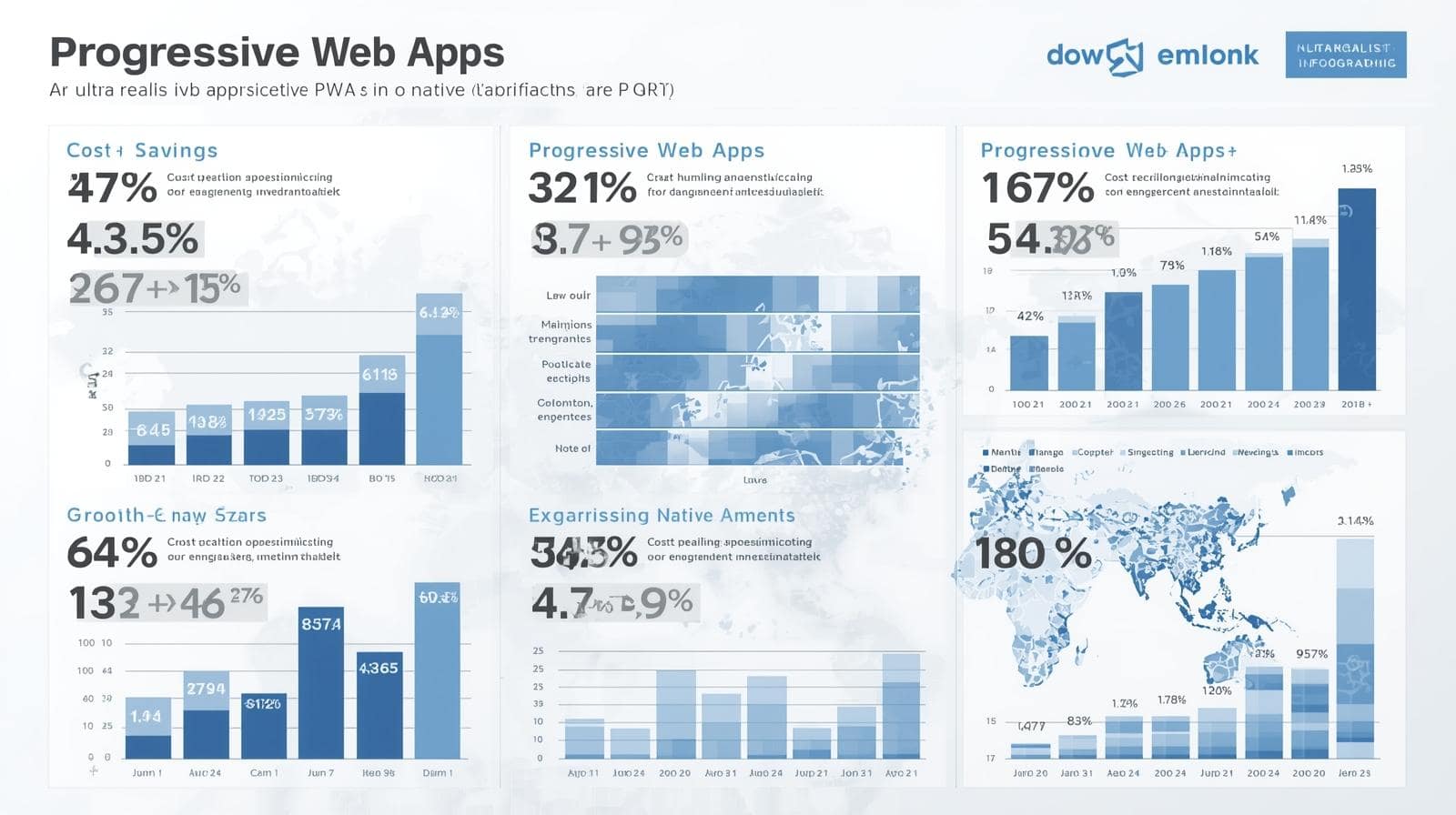
Native apps, though powerful, confine content to downloads, where user hesitation is common. Research shows 25% of installed apps are used only once.
PWAs circumvent this by offering instant access via URLs, lowering friction and boosting initial engagement.
Features like push notifications further nurture user relationships, rivaling native capabilities without equivalent hassles.
In 2025, with PWA market growth projected at 31% CAGR, businesses are increasingly adopting them for sustainable expansion.
This shift reflects PWAs’ alignment with mobile-first strategies and cost-conscious operations.
Cost-Effectiveness and Time-to-Market
PWAs excel in development speed, building once for all platforms. This unified approach minimizes redundancy and accelerates launches.
Native apps demand dual development paths, often doubling efforts and extending timelines significantly.
Maintenance for PWAs is streamlined, with updates applying universally without platform-specific adjustments.
Startups leverage PWAs for minimum viable products (MVPs), validating ideas swiftly and economically.
Established enterprises use PWAs for promotional campaigns, integrating seamlessly with existing web infrastructures.
In e-commerce, PWAs reduce abandonment rates through superior load times, directly impacting revenue.
Cost comparisons reveal PWAs at 30-50% less than natives, freeing budgets for marketing or innovation.
Time-to-market advantages allow businesses to respond agilely to market changes, gaining competitive edges.
Moreover, lower ongoing costs make PWAs sustainable for long-term digital presence.
As global mobile usage surges, PWAs’ efficiency becomes increasingly vital for business agility.
Wider Reach and Discoverability
PWAs’ URL-based access makes them inherently shareable, bypassing app store barriers entirely.
SEO integration allows ranking for relevant keywords, such as “best online shopping experience,” attracting targeted traffic.
Native apps depend on app store optimization (ASO), a competitive arena requiring reviews and downloads for visibility.
PWAs extend to desktops, providing consistent experiences across devices and building user trust.
In emerging markets with variable connectivity, PWAs adapt better, supporting low-bandwidth scenarios effectively.
This broad accessibility expands market potential, reaching users reluctant to download apps.
Statistics show PWAs increasing organic traffic by 25% or more in many cases.
Discoverability through search engines lowers customer acquisition costs compared to paid app promotions.
For global operations, PWAs simplify localization, adapting content without multiple app versions.
Ultimately, wider reach translates to higher conversion opportunities and business growth.
Improving User Engagement
Offline modes in PWAs cache content, ensuring accessibility even without connections.
Home screen additions create app-like familiarity, encouraging frequent use.
Push notifications deliver timely updates, promotions, or reminders, fostering loyalty.
Analytics reveal PWAs often achieve lower bounce rates and higher session durations.
Brands like Pinterest reported 60% engagement increases after PWA adoption.
Personalization through data caching enhances user satisfaction, driving repeat visits.
In comparison, native apps offer similar features but with added installation friction.
PWAs’ seamless integration boosts retention without extra user effort.
For content-heavy sites, PWAs provide immersive reading experiences offline.
Overall, enhanced engagement directly correlates with improved business metrics.
To elevate your digital strategy, consider our website design services at Brand Nexus Studios.
Market Adoption and Statistics
The PWA market is booming, valued at over $3.5 billion in 2024, projected to reach $5.23 billion in 2025.
Adoption rates show 31% CAGR through 2030, driven by mobile internet growth.
Regions like Asia-Pacific lead with fastest growth, fueled by e-commerce expansion.
Businesses report 82% new user growth post-PWA implementation, as seen with AliExpress.
Conversion rates climb by 104% in some cases, highlighting tangible ROI.
These stats underscore PWAs’ role in driving business success in 2025.
Large enterprises adopt PWAs for scalability, aligning with digital transformation goals.
SMEs benefit from low entry costs, democratizing advanced tech access.
Industry-wide, PWAs are reshaping user expectations for seamless experiences.
As 5G proliferates, PWAs’ performance advantages will amplify further.
Case Studies from Various Industries
In retail, Flipkart’s PWA reduced data usage by 3x, boosting conversions 70%.
Media giant Forbes saw 43% session increases, enhancing ad revenue.
Travel app Trivago reported 150% engagement uplift, improving bookings.
E-commerce leader Alibaba achieved 76% conversion growth via PWA.
These examples illustrate PWAs’ versatility across sectors.
In finance, PWAs offer secure, quick access to services offline.
Healthcare apps use PWAs for patient portals with reliable data syncing.
Education platforms deliver content seamlessly, even in low-connectivity areas.
Each case highlights tailored benefits, from cost savings to user satisfaction.
Businesses can draw inspiration for their PWA strategies.

Part 2: The Developer’s Deep Dive into PWA vs Native App
Developers navigating PWA vs native app weigh technical efficiencies against performance needs.
PWAs employ web technologies for streamlined workflows, avoiding multiple language proficiencies.
Native apps deliver peak performance through direct hardware access, crucial for AR or gaming.
Yet, PWAs are advancing with browser APIs, supporting more features like Bluetooth and NFC.

Maintenance simplicity in PWAs allows instant fixes, promoting agile methodologies.
Rapid iterations enable quick responses to user feedback and market shifts.
In 2025, tools like Workbox enhance PWA development, simplifying service worker implementations.
Developers appreciate PWAs’ lower learning curve for web-savvy teams.
However, for resource-intensive apps, native’s optimization remains superior.
Single Codebase vs Platform-Specific Approach
PWAs utilize frameworks like React or Vue for responsive interfaces across platforms.
Native requires specialized skills: Swift for iOS, Kotlin for Android, creating team silos.
Cross-platform natives via Flutter mitigate some issues, but PWAs offer simpler universality.
One update in PWAs propagates everywhere, reducing error risks.
For large teams, PWAs facilitate collaboration without platform divisions.
Yet, natives allow fine-tuned optimizations per OS, enhancing user experiences.
In practice, PWAs suit most applications, reserving natives for specialized needs.
Development efficiency favors PWAs, with faster prototyping and deployment.
As web standards evolve, PWAs’ codebase advantages strengthen.
Developers should assess project scope to choose appropriately.
Performance and Device Feature Access
Native apps compile to machine code, ensuring swift execution.
PWAs rely on browsers, but technologies like WebAssembly accelerate computations.
Device APIs: Natives enjoy unrestricted access; PWAs use permission-based subsets.
By 2025, PWAs support emerging features like WebGPU for advanced graphics.
For everyday apps, PWAs perform adequately; intensive tasks favor natives.
Optimization techniques in PWAs, like lazy loading, bridge performance gaps.
Browser improvements continually enhance PWA capabilities.
Developers must balance feature needs with performance requirements.
In AR/VR, natives dominate due to hardware demands.
Future APIs may equalize access, favoring PWAs long-term.
Ease of Maintenance and Updates
PWAs update transparently upon refresh, bypassing store queues.
Native updates endure review processes, potentially delaying critical fixes.
A/B testing thrives in PWAs with quick variant deployments.
Security patches apply immediately in PWAs, vital for compliance.
Tools like Google Lighthouse audit PWAs, ensuring best practices adherence.
Maintenance costs drop with PWAs’ unified approach.
Version control simplifies in PWAs, avoiding multi-platform discrepancies.
Developers value the agility PWAs provide in dynamic environments.
For global apps, instant updates ensure uniform experiences.
Overall, PWAs streamline lifecycle management effectively.
Developer Best Practices for PWAs
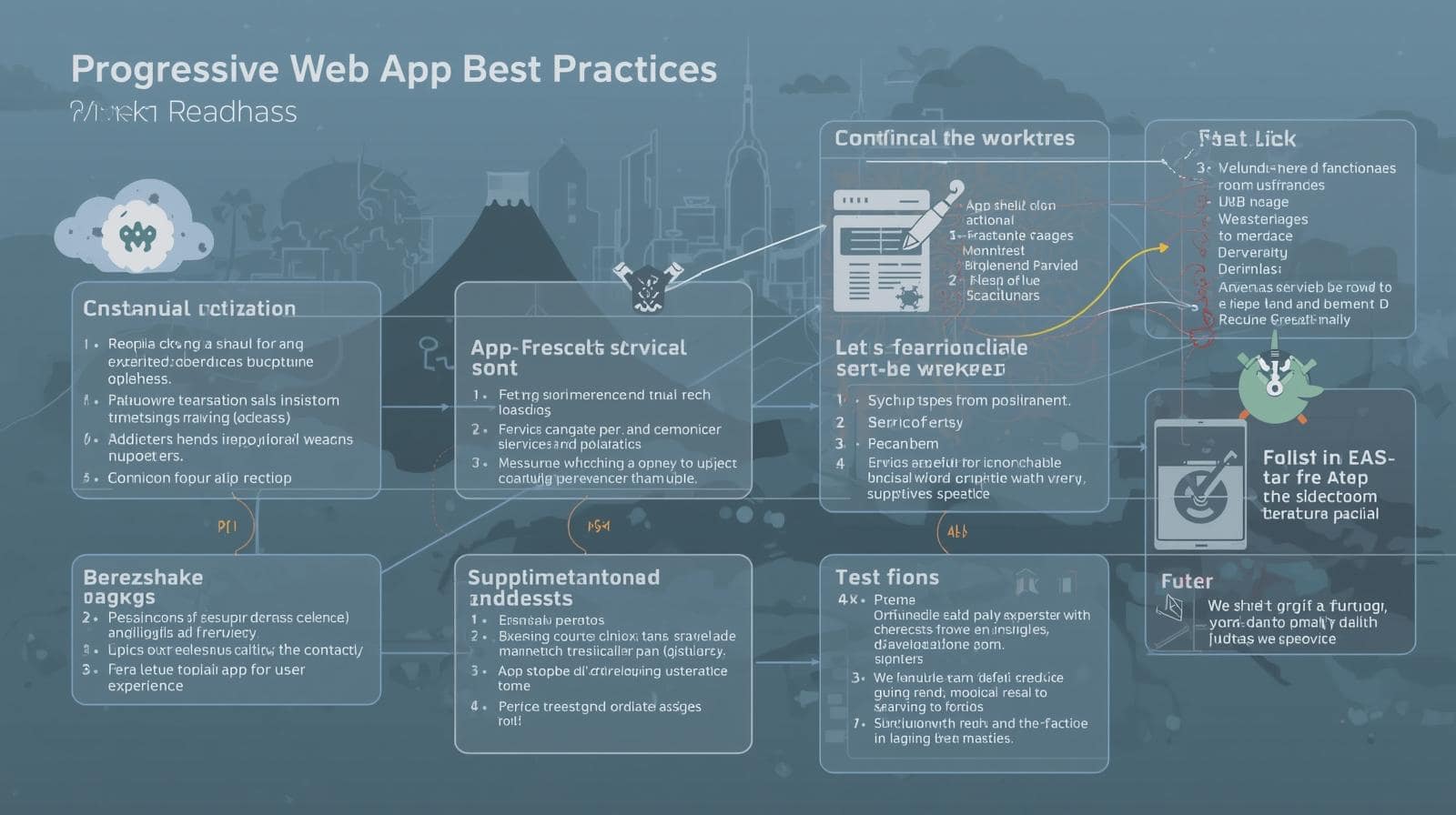
Adopt App Shell architecture for instant UI loading, caching core elements.
Implement service workers for offline handling and network resilience.
Optimize assets: compress images, minify scripts for speed.
Enforce HTTPS for security and feature enablement.
Test on diverse devices, emulating real-world conditions.
Monitor with analytics, iterating on performance data.
Use manifests for installability and customization.
Handle caching strategies carefully to avoid stale content.
Incorporate accessibility standards for inclusive design.
Stay updated with browser API advancements.
Limitations and Platform Support
PWAs operate across browsers, but iOS features lag, like limited push notifications.
Overcome by hybrid wrappers like Capacitor for enhanced capabilities.
Browser inconsistencies require polyfills and testing.
Offline storage limits exist, manageable with IndexedDB.
Future standards aim to close gaps, improving parity.
Android offers fuller support, ideal for initial deployments.
Developers should monitor Apple’s PWA progress.
Limitations in hardware access persist for certain APIs.
Strategies include graceful degradation for unsupported features.
Despite challenges, PWAs’ flexibility outweighs drawbacks for many.
Overcoming PWA Limitations
Address discoverability with SEO and marketing campaigns.
Enhance installation prompts for better user adoption.
Use progressive enhancement for feature availability.
Implement fallback mechanisms for offline scenarios.
Leverage community tools for cross-browser consistency.
Monitor user feedback to iterate on pain points.
Combine with native elements in hybrid models.
Focus on core features first, expanding gradually.
Educate users on PWA benefits to boost acceptance.
These tactics mitigate limitations effectively.
Case Studies: PWA Success Stories
AliExpress’s PWA yielded 82% user growth and 104% conversion uplift.
Uber’s PWA loads in 2 seconds on slow networks, expanding reach.
Forbes achieved 43% more sessions, enhancing content consumption.
Starbucks saw 2x daily users with offline ordering features.
Kaporal reduced bounces by 60%, increasing conversions 15%.
Devialet doubled conversions with organic traffic up 25%.
Thomas Kent lowered bounces 57%, revenue from organic up 79%.
These stories showcase PWAs’ impact on key metrics.
In retail, PWAs streamline shopping with fast, reliable interfaces.
Media apps benefit from quick content delivery and engagement.

Native App Wins: When to Choose Them
For VR/AR experiences, native’s hardware integration is essential.
Banking apps prioritize native for top-tier security features.
High-end games like PUBG demand native performance levels.
App store ecosystems benefit natives with monetization options.
Industries requiring precise sensor data favor natives.
Complex computations in scientific apps suit native optimization.
Where user interface polish is critical, natives excel.
Hybrid strategies combine both for comprehensive solutions.
Evaluate if advanced features justify higher costs.
Natives remain ideal for performance-driven applications.
2025 Trends in PWA vs Native App
2025 sees PWAs integrating AI for smarter interactions.
Web ML APIs enable on-device processing efficiently.
Native apps advance with modular designs and cross-platform tools.
PWAs’ web foundation makes them adaptable to emerging tech.
5G enhances PWAs, minimizing performance disparities.
Browser enhancements close feature gaps progressively.
Hybrid models blend PWA accessibility with native power.
App stores lose dominance as PWAs rise.
Offline-first designs become standard in PWAs.
Monetization shifts towards instant PWA models.

For innovative solutions, check our PPC services.
AI and ML Integration Trends
PWAs incorporate AI for personalized content delivery.
On-device ML reduces latency, enhancing responsiveness.
Native apps use AI for advanced analytics and predictions.
Trends favor hybrid AI implementations for optimal results.
Voice interfaces emerge in PWAs via web speech APIs.
Predictive caching in PWAs anticipates user needs.
AI-driven security bolsters PWA trustworthiness.
Developers explore edge computing for faster processing.
These integrations elevate user experiences significantly.
Businesses leverage AI for competitive differentiation.
Security and Privacy Enhancements
PWAs adopt WebAuthn for biometric authentication.
Native apps integrate advanced encryption natively.
Privacy-focused designs comply with global regulations.
Secure enclaves in natives protect sensitive data.
PWAs use HTTPS mandates for data integrity.
Trends emphasize user consent in data handling.
Zero-trust models apply to both technologies.
Developers prioritize auditing for vulnerabilities.
Enhanced security builds user confidence.
Future updates focus on quantum-resistant cryptography.
Hybrid Approaches: Best of Both Worlds
Hybrid apps like those built with React Native compile to native while sharing code.
PWAs complement hybrids for robust web presences.
Assess requirements: start with PWA, escalate to native as needed.
This phased approach optimizes resources efficiently.
Tools like Ionic enable hybrid development seamlessly.
Benefits include cost savings and performance balances.
For e-commerce, hybrids offer app-like feels with web reach.
Developers appreciate flexibility in tool choices.
Hybrid strategies mitigate individual tech limitations.
Future trends may blur lines between PWA and hybrid further.
How to Decide: PWA vs Native App Checklist
- Budget limited? Opt for PWA.
- Require deep hardware integration? Select native.
- Aim for broad accessibility? Choose PWA.
- Need rapid updates? PWA excels.
- Performance paramount? Go native.
- Target SEO benefits? PWA wins.
- Plan for offline use? Both viable, but evaluate.
- Consider maintenance long-term? PWA simpler.
- Industry-specific needs? Research accordingly.
- Future scalability? PWA adaptable.
Use this checklist for informed decisions.
FAQs
What is the main difference in development for PWA vs native app?
PWAs use a single codebase for cross-platform compatibility, while native apps require separate development for iOS and Android, increasing time and cost.
Which is cheaper: PWA or native app?
PWAs are generally cheaper due to reduced development and maintenance efforts compared to native apps.
Can PWAs work offline like native apps?
Yes, PWAs can offer offline functionality through service workers, similar to native apps.
Are PWAs discoverable by search engines?
PWAs are indexable by search engines, boosting SEO, unlike native apps confined to app stores.
What are the performance trade-offs in PWA vs native app?
Native apps often provide superior performance for intensive tasks, but PWAs are closing the gap with modern web technologies.
How do PWAs impact business growth in 2025?
PWAs drive growth through cost savings, wider reach, and improved engagement, with market projections showing rapid adoption.
What future trends are shaping PWA vs native app?
Trends include AI integration, better offline capabilities, and hybrid approaches blending both technologies.
Conclusion
The PWA vs native app discourse positions PWAs as versatile, cost-effective options for many scenarios. They deliver substantial benefits in reach and engagement with minimal trade-offs.
Native apps hold ground for specialized, high-performance needs. Carefully weigh your objectives.
Ready to implement a PWA? Reach out to Brand Nexus Studios, experts in digital marketing and website development, at morne@brandnexusstudios.co.za. Let’s propel your brand forward.
References
About the Author