

HTTP/3 SEO aligns speed and discoverability. All images on this page are compressed for faster loading.
HTTP/3 SEO: 9 Proven Wins For Faster Rankings
By Morne de Heer, Published by Brand Nexus Studios

Speed wins clicks. That is why HTTP/3 SEO is a powerful way to lift performance signals that influence rankings and revenue. If faster pages convert better, HTTP/3 helps you get there faster and more reliably.
Here is the short version. HTTP/3 SEO upgrades the transport layer to QUIC over UDP, trims handshake time, and avoids head of line blocking. The result is smoother delivery under real world conditions, which helps Core Web Vitals and crawl efficiency.
You want practical steps, not theory. This guide gives you clear wins, a rollout checklist, and measurement tactics for HTTP/3 SEO that you can use today.
HTTP/3 SEO explained in plain English
Think of HTTP/3 SEO as a transport upgrade that benefits your entire site. QUIC runs over UDP, so connections start quicker and recover better on flaky mobile networks. That cuts latency and keeps pages moving even when packets drop.
With HTTP/3, multiplexing is native. Streams do not block each other when one packet goes missing. That removes the head of line pain you get with TCP. For SEO, this means render critical resources reach the browser sooner and more consistently.
Yes, content quality still rules. Yet transport level gains from HTTP/3 SEO amplify every other optimization you ship, from image compression to caching to code splitting.
Why HTTP/3 SEO matters for rankings and revenue
First impressions count. HTTP/3 SEO often reduces TTFB and improves LCP by shaving round trips during connection setup and by surviving packet loss. Better early paint equals calmer users and lower bounce rates.
Mobile traffic deserves special care. HTTP/3 SEO adapts in motion with connection migration. When users move between networks, QUIC keeps the session alive more often. That means more completed sessions, carts, and forms.
Search engines watch user experience signals. While HTTP/3 is not a direct ranking factor, the UX lift supports Core Web Vitals and page experience, both vital levers for technical SEO.
9 proven HTTP/3 SEO wins you can ship this quarter
1) Faster TTFB with HTTP/3 SEO
Start strong. HTTP/3 SEO reduces handshake overhead with TLS 1.3 and can leverage session resumption. Quicker first byte improves perceived speed and can stabilize LCP on real devices.
- Enable QUIC alongside HTTP/2 for graceful fallback.
- Use TLS 1.3 and keep cipher suites lean.
- Place compute near users with a CDN to shorten hops.
2) Better LCP through HTTP/3 SEO
Render faster. HTTP/3 SEO delivers hero images, web fonts, and critical CSS more reliably under loss. That helps you hit LCP targets across 4G and congested Wi Fi scenarios.
- Inline critical CSS and preload the LCP resource.
- Serve AVIF or WebP images and compress aggressively.
- Resize and lazy load non critical media.
3) No head of line blocking with HTTP/3 SEO
Keep streams flowing. HTTP/3 SEO avoids TCP level head of line blocking. When a packet drops, only the affected stream waits. That stability helps render pipelines keep pace.
- Bundle less, cache more, and let multiplexing shine.
- Prefer HTTP caching to client side waterfalls.
4) Mobile resilience from HTTP/3 SEO
Meet users where they are. HTTP/3 SEO thrives on high latency or lossy links, so mobile visitors see fewer stalls and replays. That steadiness feeds better engagement signals.
- Audit third party scripts that slow mobile.
- Delay non essential tags with consent or interaction.
- Ship smaller JavaScript and use priority hints.
5) Connection reuse at scale with HTTP/3 SEO
Consolidate hosts. HTTP/3 SEO supports efficient multiplexing across many assets. Fewer DNS lookups and faster resumption cut overhead and smooth out performance spikes.
- Reduce domain sharding that made sense for HTTP/1.1.
- Adopt connection coalescing where possible.
6) Crawl efficiency uplift via HTTP/3 SEO
Help bots help you. HTTP/3 SEO can shorten response times and lower retries, so crawlers fetch more URLs per visit. That supports fresher indexing on large or frequently updated sites.
- Keep sitemaps fresh and lean to guide crawlers.
- Use caching headers that fit content volatility.
7) Edge delivery synergy with HTTP/3 SEO
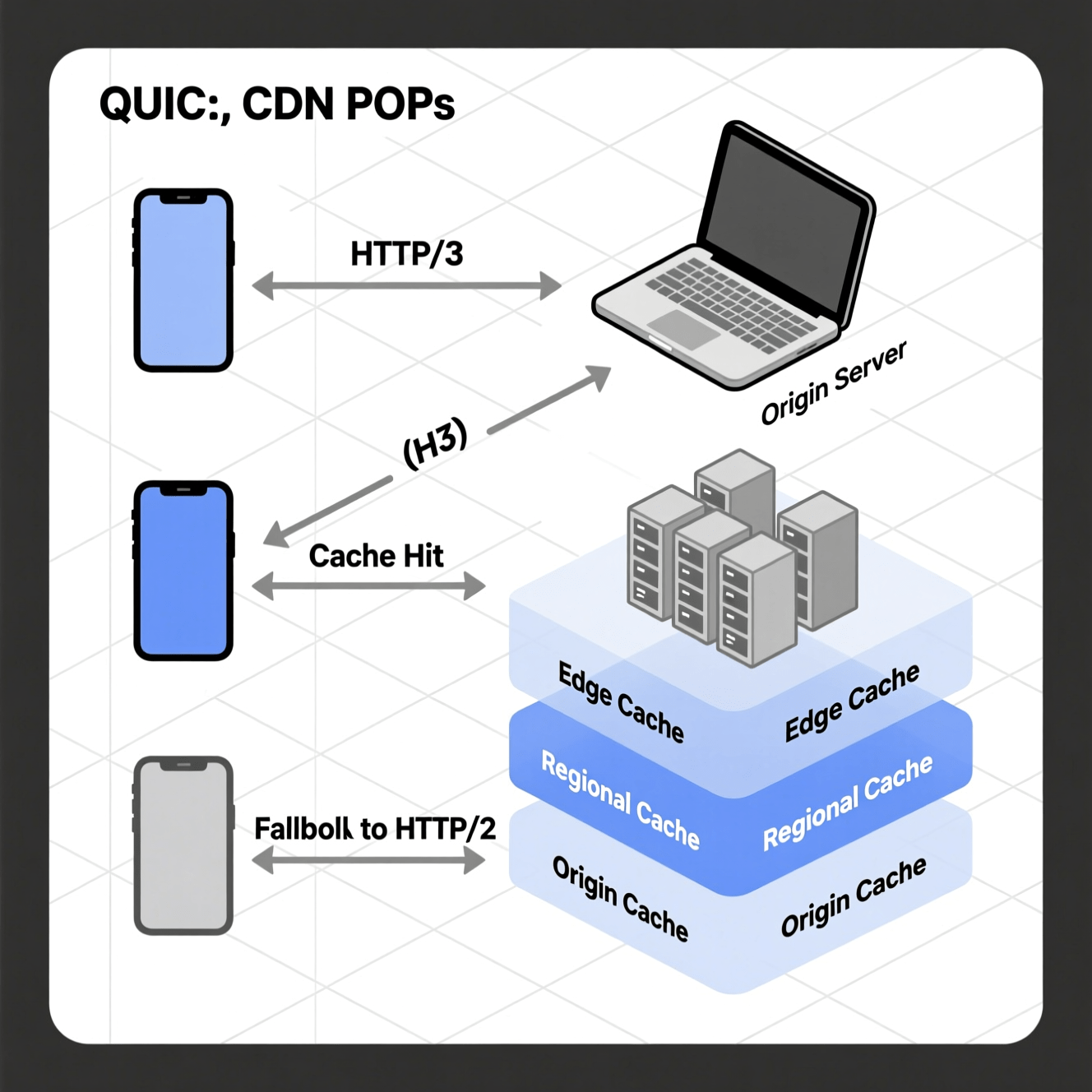
Go global. HTTP/3 SEO pairs nicely with a CDN that terminates QUIC near the user. Edge routing plus smart caching slashes geographic latency and steadies Core Web Vitals.
- Warm edge caches for key landing pages.
- Use tiered caching to protect origin capacity.
8) Security and speed with HTTP/3 SEO
Encrypt without drag. HTTP/3 SEO runs on TLS 1.3 by default. Modern ciphers, session tickets, and 0 RTT resumption can speed return visits when used carefully.
- Rotate keys and manage session tickets securely.
- Measure resumption hit rates and error trends.
9) Global reliability with HTTP/3 SEO
Stay connected. HTTP/3 SEO benefits from connection migration and loss recovery. Users who move between networks are less likely to hit failures mid session.
- Open UDP 443 and monitor middlebox behavior.
- Keep an eye on protocol negotiation errors.

HTTP/3 SEO fundamentals you should know
Start with the transport. QUIC is user space, encrypted, and runs over UDP. That makes evolution faster than kernel bound TCP stacks and helps multiplex streams with less penalty when packets drop.
Mind the headers. The Alt Svc response header advertises HTTP/3 availability. Clients can upgrade on future requests after learning the endpoint. Keep HTTP/2 available during rollout to avoid breaking early traffic.
Expect mixed clients. HTTP/3 SEO is an additive win. Not every visitor will use it on day one, which is why you keep fallbacks strong and measure protocol adoption over time.
Step by step rollout: your HTTP/3 SEO plan
Ship value in phases. The cleanest way to roll out HTTP/3 SEO is to enable it behind a CDN, then measure, then harden, then scale. Use the steps below as your field guide.
Phase 1: Assess and prepare for HTTP/3 SEO
- Inventory your stack. CDN, WAF, origin server, load balancer, and firewall rules.
- Confirm QUIC and HTTP/3 support in your CDN or server build.
- Upgrade to TLS 1.3 and prune legacy ciphers.
- Open UDP 443 on edge and origin paths where required.
Phase 2: Enable and contain HTTP/3 SEO
- Turn on HTTP/3 and keep HTTP/2 fallback active.
- Serve Alt Svc and verify protocol negotiation in DevTools.
- Canary release to a slice of traffic and monitor errors.
- Keep caches warm and verify cache hit ratios do not regress.
Phase 3: Optimize around HTTP/3 SEO
- Compress images, fonts, and JSON aggressively. Prefer AVIF or WebP for images.
- Adopt responsive images with sizes and srcset. Lazy load offscreen media.
- Tune caching with Cache Control, ETag, and stale while revalidate.
- Trim JavaScript, defer non critical bundles, and use priority hints for LCP.
Phase 4: Measure and iterate on HTTP/3 SEO
- Track protocol adoption, TTFB, LCP, CLS, and INP by device and location.
- Compare cohorts with and without HTTP/3 to isolate impact.
- Watch error rates, UDP loss patterns, and fallback frequency.
- Share wins with stakeholders and bake lessons into your playbook.

Measurement that proves your HTTP/3 SEO wins
Prove it with data. Your HTTP/3 SEO story lands when you show lower TTFB and better LCP in the field. Laboratory tests are useful, but field data seals the deal.
Segment by protocol. Tag performance logs with the negotiated protocol so you can compare HTTP/2 and HTTP/3 sessions side by side. Watch for better tail performance, not only median.
Cross check Core Web Vitals. LCP should stabilize, INP should stay steady or improve, and CLS should remain unaffected by transport changes. If LCP regresses, recheck priority hints and preload strategy.
Layer business metrics. Tie HTTP/3 SEO improvements to session length, bounce rate, and conversion. This helps you fund further technical SEO work with clear ROI.
HTTP/3 SEO on WordPress and popular stacks
Good news. You do not need to rebuild your site to benefit from HTTP/3 SEO. Most wins come from the edge and from resource prioritization in your theme.
- WordPress: Run a CDN that supports HTTP/3, enable QUIC, and keep caching plugins tuned for Cache Control and compression.
- Headless: Serve static assets from a CDN with HTTP/3 and precompute critical CSS for each route.
- SaaS: Ask your vendor about QUIC and protocol roadmaps, then measure with synthetic and real user data.
If you want expert help, the SEO services team at Brand Nexus Studios can plan and roll out HTTP/3 SEO changes while protecting your Core Web Vitals baselines.
Content and structure tips that pair with HTTP/3 SEO
Do the basics well. HTTP/3 SEO multiplies gains when your site ships clean markup, strong semantics, and relevant content that matches intent.
- Keep title tags and meta descriptions compelling and accurate.
- Use descriptive alt text and filenames for images. Compress everything.
- Adopt internal linking that mirrors user journeys and topics.
- Minimize render blocking resources and avoid layout shifts.
When you renovate templates, fold in website design and development improvements with lightweight components and smart caching that amplify HTTP/3 SEO benefits.

Protocol checks and configuration for HTTP/3 SEO
Verify the protocol. In your browser, open DevTools, load your page, and inspect the protocol column in the network panel. You should see h3 for HTTP/3 sessions when QUIC is active.
Confirm headers. Look for Alt Svc with an h3 directive and check Cache Control policies for static and dynamic assets. Strong caching magnifies HTTP/3 SEO gains by cutting repeat fetches.
Watch UDP realities. Firewalls, proxies, and some corporate networks still block UDP. Keep HTTP/2 in place and track fallback rates so you understand real world coverage.
Image compression and caching that boost HTTP/3 SEO
Compress everything. HTTP/3 SEO shines when payloads are small. Use AVIF or high quality WebP with efficient color profiles. Strip metadata where it is not needed.
- Adopt responsive images with sizes and srcset for mobile and desktop.
- Serve immutable static assets with long max age and versioned URLs.
- Enable Brotli for text and keep Gzip as fallback.
Cache smartly. Stale while revalidate smooths cache misses and keeps pages responsive. With HTTP/3 SEO in place, your cache and transport reinforce each other for a smoother user experience.

Avoid these pitfalls when shipping HTTP/3 SEO
Do not skip measurement. HTTP/3 SEO is about outcomes, not toggles. Without protocol segmented data, you cannot prove success or find regressions.
Do not break corporate users. Some networks still block UDP. Keep HTTP/2 fallback healthy and monitor support tickets and error logs after rollout.
Do not ignore priority. The transport is faster, but you still need to prioritize the LCP image, fonts, and above the fold CSS. Pair preload, priority hints, and resource hints with HTTP/3 SEO.
Do not fragment domains. Legacy sharding limits HTTP/3 multiplexing. Consolidate assets where practical to reduce DNS and TLS overhead.
Analytics that validate HTTP/3 SEO improvements
Bring data together. Correlate protocol, geography, device class, and conversion. Over time, HTTP/3 SEO should reduce long tail latency and stabilize key journeys.
Set targets. For example, reduce LCP p75 by 150 ms on mobile and lift conversion by 1 percent on key funnels. Track weekly to catch drift early.
If you need a reporting partner, Brand Nexus Studios offers analytics and reporting that maps HTTP/3 SEO gains to business outcomes you can defend in the boardroom.
Quick checks to confirm your HTTP/3 SEO setup
- Protocol shows h3 for a meaningful slice of traffic.
- UDP 443 is open and error rates are steady or lower.
- Core Web Vitals do not regress after rollout.
- CDN cache hit ratio is stable or higher.
- Static assets use long lived caching with versioned URLs.
- Images are compressed and responsive. Lazy loading is in place.
- DNS, TLS, and TCP metrics trend down for upgraded sessions.
FAQ: your top HTTP/3 SEO questions answered
What is HTTP/3 SEO? It is the practice of using HTTP/3 and QUIC to improve site performance signals that support search visibility and growth.
Is HTTP/3 a ranking factor? No. But HTTP/3 SEO can boost Core Web Vitals and page experience, which influence rankings and engagement.
How do I test if HTTP/3 is active? Use DevTools and inspect the network protocol, or run command line tests that negotiate h3. Your CDN dashboard may also show adoption.
Will HTTP/3 fix poor code or heavy pages? No. HTTP/3 SEO amplifies good practices. You still need clean markup, compressed media, and smart caching.
Do I need new hosting? Not always. Many CDNs add HTTP/3 in front of your origin, so you can benefit without changing hosts.
Is HTTP/3 secure? Yes. It uses TLS 1.3 and modern cryptography by default.
Will crawlers use HTTP/3? Adoption varies, but faster response and lower error rates still help crawl efficiency even with mixed protocol use.
Can Brand Nexus Studios help? Yes. Our team can plan and implement HTTP/3 SEO changes and measure the impact so you can prioritize next steps with confidence.
Putting HTTP/3 SEO to work today
Move now. Turn on HTTP/3 at your CDN, compress images harder, fix priority for the LCP resource, and watch your real user data for wins. This is high leverage work that compounds.
Need a partner for rollout and measurement at scale? Brand Nexus Studios has helped teams blend transport upgrades with on page SEO to produce durable gains that stick.
References
Read more from the sources below. These links open in a new tab.
About the Author





It’s great how HTTP/3 addresses both speed and crawl efficiency. One thing I’ve noticed is how the reduced latency really impacts the user experience, particularly for mobile users. Implementing HTTP/3 could be the edge some sites need to improve rankings!
Spot on – reduced latency from QUIC really shines on mobile, where packet loss and network switches are common. Even if most crawling still happens over HTTP/2 today, the gains from HTTP/3 often show up in Core Web Vitals (TTFB, LCP, INP), which is where rankings can benefit. The nice part: on most CDNs it’s a quick enable – keep HTTP/2 fallback and monitor RUM by device/connection to validate the lift. Have you seen measurable LCP or TTFB improvements since turning on H3?
Nice write-up on HTTP/3 SEO: 9 Proven Wins For Faster Rankings. The note on BusinessDigital Marketing HTTP/3 SEO: 9 Proven Wins For Faster Rankings Morne de was helpful. If you’re into AI image editing, text-to-image online works well for quick iterations.
This was a super clear explanation of HTTP/3 SEO! I totally agree that the UX lift for Core Web Vitals, especially on mobile networks, makes a huge difference even if it’s not a direct ranking factor. For anyone interested